 ultimate-guide
Leadership Development for Healthcare Managers: A Practical Guide
Table of Contents
- Why Leadership Development Matters in Healthcare
- Core Healthcare Leadership Competencies You Need to Master
- Healthcare Management Training Programs That Drive Results
- Building a Leadership Development Plan for Nurses and Clinical Staff
- Measuring ROI of Healthcare Leadership Training
- Overcoming Common Leadership Challenges in Healthcare Settings
- Character-Driven Leadership: Moving Beyond Titles and Credentials
- Conclusion
Last Updated: August 7, 2026
Why Leadership Development Matters in Healthcare
Healthcare organizations face a critical talent crisis. Burnout rates among clinical staff have reached unprecedented levels, and the pipeline of emerging leaders is drying up. Organizations that invest in developing their managers see measurable improvements in staff retention, patient outcomes, and organizational culture. The stakes are higher in healthcare than most industries, when a manager fails, the impact cascades across patient care, staff morale, and clinical outcomes. Traditional leadership training programs weren't designed for healthcare and don't account for the unique pressures of clinical environments, regulatory complexities, or the fact that many healthcare managers are promoted from clinical roles without formal leadership training.
Core Healthcare Leadership Competencies You Need to Master
Not all leadership competencies are created equal in healthcare. The competencies that matter most directly influence patient outcomes, staff engagement, and organizational culture.
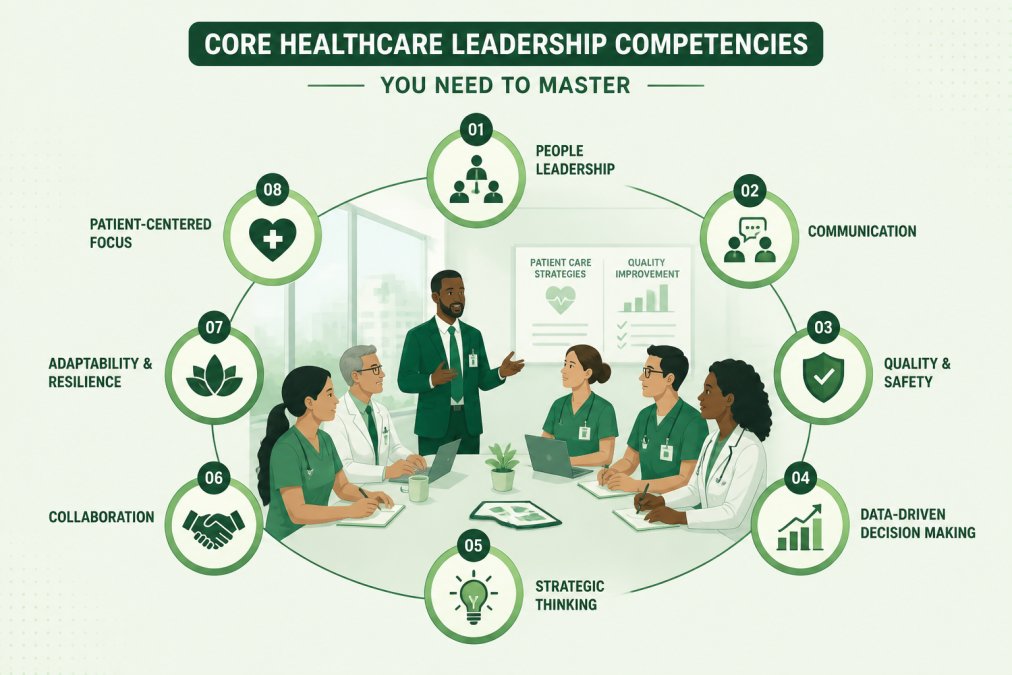
Core competencies fall into three categories: technical (clinical knowledge and healthcare systems understanding), operational (quality improvement, financial acumen, strategic planning), and relational (emotional intelligence, communication, conflict resolution). Most healthcare managers excel in one or two categories. Those who rise to senior leadership develop competency across all three.
Emotional Intelligence and Clinical Relationships
Emotional intelligence in healthcare is the ability to read a room full of stressed clinicians, understand what's driving their frustration, and respond in ways that maintain psychological safety while holding people accountable. Clinical environments are uniquely emotionally charged. Managers who understand this and acknowledge the emotional weight of clinical work rather than pretending it doesn't exist build teams that perform better and stay longer.
A common mistake is assuming emotional intelligence means being nice. It means being direct about performance issues while acknowledging the context in which people are working. A manager with high emotional intelligence can tell a team member their work isn't meeting standards while also recognizing the impossible patient load they've been carrying.
Change Management and Organizational Culture
Healthcare organizations are in constant change. New regulations, technologies, care models, and reimbursement structures create relentless pressure. Managers who can't lead change effectively become bottlenecks. Change management in healthcare is complicated by the fact that clinical staff often have legitimate concerns about how changes affect patient care. A manager who acknowledges the real costs of change while still moving the organization forward builds credibility.
Organizational culture in healthcare is shaped by how managers handle the invisible work: emotional labor, moral distress, and decisions that don't have good options. Managers who acknowledge this reality and create space for it build stronger teams.
Quality Improvement and Patient Outcomes
Quality improvement isn't a program you run, it's a way of thinking about your work. Managers who understand how their decisions affect patient outcomes make different choices than managers focused purely on efficiency or cost. A manager might choose to staff at a higher level than the minimum required because they understand that understaffing increases medication errors.
Quality improvement as a leadership competency means understanding data, operational data, wait times, readmission rates, process bottlenecks. Managers who can read this data and engage their teams in solving problems drive real results.
Healthcare Management Training Programs That Drive Results
Programs that drive results in healthcare are grounded in the realities of clinical environments, acknowledging constraints, regulatory requirements, and patient safety concerns. They focus on application, not theory, including case studies from healthcare settings and role-playing scenarios that mirror real situations managers face.
Effective programs include peer learning, bringing managers together from different departments or organizations to learn from each other's experiences. They also include follow-up and accountability, a two-day training program followed by nothing doesn't change behavior. Programs that include coaching or structured follow-up over 90 days see dramatically better results.
When evaluating a healthcare management training program, ask whether it includes clinical case studies, addresses the specific challenges your managers face, and includes a mechanism for follow-up.
Building a Leadership Development Plan for Nurses and Clinical Staff
A leadership development plan is a targeted roadmap that identifies where an individual is now, where they need to go, and the specific steps to get there. For nurses and clinical staff, this is especially important because many have never had formal leadership training.
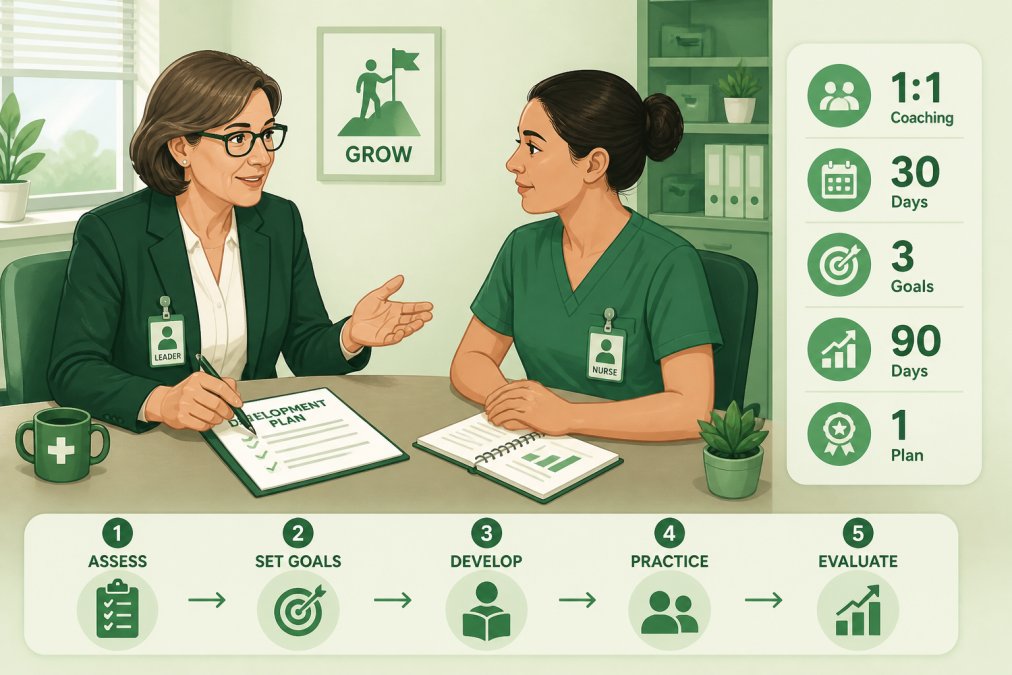
The first step is honest assessment. Where does this person excel? Where do they struggle? What's their appetite for leadership? Not every strong clinician wants to be a manager, and that's okay. For those who do want to move into formal leadership, the plan should address gaps between their current state and what's required for the target role.
Identifying High-Potential Clinical Leaders
Not every high performer is a high-potential leader. High performers are good at their current job. High-potential leaders can grow into bigger roles. High-potential clinical leaders typically show several characteristics: they're curious and ask questions about how things work; they seek feedback and use it; they think beyond their immediate role; they can influence people without formal authority; they're comfortable with ambiguity and navigate change without needing everything spelled out.
A common mistake is confusing tenure with potential. Look at growth trajectory and learning agility, not just tenure.
Creating Mentorship and Succession Pathways
Mentorship in healthcare works best when it's structured but not rigid. Effective mentorship includes several components: the mentor models the behaviors and competencies the mentee needs to develop; they create space for the mentee to make mistakes and learn; they introduce the mentee to networks and opportunities; and they're honest about what it takes to succeed in healthcare leadership.
Succession planning identifies critical roles, identifies people who could fill those roles, and creates intentional development pathways. The best plans identify multiple potential successors for each critical role. A common mistake is waiting until someone is about to leave to develop their successor.
Measuring ROI of Healthcare Leadership Training
Most healthcare organizations don't measure the ROI of leadership training. But it's measurable. The metrics that matter most are staff retention (especially for high performers), patient safety metrics (adverse events, near misses, safety culture surveys), quality metrics (readmissions, patient satisfaction, clinical outcomes), and financial metrics (overtime costs, turnover costs, productivity).
Leadership development isn't a quick fix. Most organizations see measurable improvement in retention and culture within 6-12 months, but full ROI often takes 18-24 months. To measure ROI, establish a baseline of current metrics, then measure the same metrics again after implementing leadership development.
Overcoming Common Leadership Challenges in Healthcare Settings
Every healthcare organization faces similar leadership challenges. The managers who succeed understand these challenges aren't personal failures, they're systemic issues requiring intentional responses.
Managing Burnout and Building Staff Retention
Staff burnout in healthcare is at crisis levels. The primary driver isn't pay, it's the feeling that work doesn't matter, the system doesn't care, and leadership doesn't understand what they're dealing with. A manager can't fix the entire healthcare system, but can create a unit where people feel valued, where their work is acknowledged, and where they have some control over their environment.
Managing burnout starts with acknowledging it. A manager who acknowledges real pressures and works with their team to address what's controllable builds trust. Building staff retention is about creating an environment where people want to come to work through meaningful work, autonomy, and leadership support.
Leading Effectively in Hybrid and Remote Healthcare Environments
Clinical work can't always be done remotely, but administrative work, some education, and some clinical work like telehealth can be. The challenge is creating cohesive team culture when people aren't physically together. Effective managers in hybrid settings are intentional about communication, scheduling regular one-on-ones, creating space for informal connection, and being transparent about decisions.
Remote work requires trust. A manager who micromanages in a remote environment drives good people away. A manager who trusts their team to get work done and focuses on outcomes rather than activity builds stronger teams.
Fostering Diversity, Equity, and Inclusion in Clinical Teams
Healthcare leadership that reflects the diversity of communities served is better for patients and organizations. Diversity is about representation. Equity is about creating systems where everyone has access to the same opportunities and support. Inclusion is about creating a culture where everyone feels they belong and can bring their authentic selves to work.
In clinical settings, this means examining hiring practices, whether people from underrepresented groups are promoted at the same rates, and creating psychological safety for people to speak up about discrimination or exclusion. A common mistake is assuming that hiring diverse people is enough. Inclusion is the ongoing work of creating an environment where diverse people stay, thrive, and advance.
Character-Driven Leadership: Moving Beyond Titles and Credentials
Here's what separates technically competent managers from managers who actually lead: character. A manager with a title but no character can manage systems and processes, but can't inspire people to do their best work. A manager with character, integrity, humility, courage, and commitment to something bigger than themselves, builds teams that perform and stay.
Character-driven leadership means your identity as a leader isn't about your title. It's about who you are and how you show up in your work. A character-driven leader admits mistakes, asks for help, and is willing to be vulnerable with their team about what they don't know. They make decisions aligned with their values, even when it's difficult.
In healthcare, character matters more than in most fields because people are watching how you handle difficult situations. The healthcare managers who build the strongest teams and see the best outcomes understand that leadership is fundamentally about character. They've done the work to understand their own values, triggers, and how they show up under stress.
Building character-driven leadership means investing in self-awareness, getting honest feedback about how you're perceived, and doing the hard work of changing deeply ingrained patterns. It's not quick, but it's the most sustainable path to becoming a leader people want to follow.
Leadership development for healthcare managers isn't a luxury, it's a strategic necessity. Organizations that invest in developing their managers see measurable improvements in staff retention, patient outcomes, and organizational culture. If you're struggling with team engagement, succession planning, or the feeling that your managers aren't leading effectively, the answer often isn't better processes or systems. It's developing the leaders you have.
Jim Carlough works with healthcare leaders to build character-driven leadership through executive coaching, keynote speaking, and developmental programs designed to move beyond titles and credentials. With over 30 years of experience in enterprise transformation, Jim helps healthcare managers develop the confidence, clarity, and influence they need to lead effectively in complex clinical environments. [BOOK JIM TO SPEAK] to bring this approach to your organization.
Frequently Asked Questions
What are the core leadership competencies for healthcare managers?
Healthcare managers need emotional intelligence to navigate complex team dynamics and patient-centered care environments. Critical competencies include change management to guide staff through organizational shifts, quality improvement skills to enhance patient outcomes, conflict resolution to address interdisciplinary tensions, financial acumen to manage budgets, and strategic planning to align operations with healthcare policy. Strong communication, adaptability, and the ability to build trust across clinical teams are equally essential. These competencies go beyond technical skills, they require authentic presence and the ability to connect with staff on a human level.
How do you measure the ROI of healthcare leadership training?
Track specific performance metrics tied to your training investment: staff retention rates, employee engagement scores, patient satisfaction (HCAHPS), quality improvement metrics, and operational efficiency gains. Monitor leadership pipeline development by measuring internal promotion rates and time-to-fill critical roles. Financial ROI appears through reduced turnover costs, improved productivity, and enhanced patient outcomes that affect reimbursement. Survey participants before and after training to assess confidence, decision-making clarity, and influence. The strongest indicator is behavioral change, how leaders actually show up in meetings and with their teams, not just training completion rates.
Why is developing a leadership development plan for nurses critical in healthcare?
Nurses represent the largest clinical workforce and often feel overlooked for leadership opportunities despite their frontline insights. A structured development plan identifies high-potential nurses early, provides mentorship pathways, and builds a sustainable leadership pipeline. This directly impacts staff retention, patient outcomes, and organizational culture. When nurses see a clear route to advancement and feel supported in developing leadership competencies, engagement increases, burnout decreases, and clinical teams become more cohesive. It also ensures that clinical expertise directly informs organizational decision-making.
What's the difference between generic leadership training and healthcare-specific development?
Healthcare-specific leadership development addresses the unique pressures of clinical environments: regulatory compliance, patient safety, interdisciplinary collaboration, and the emotional toll of healthcare work. Generic programs miss the complexity of managing physicians, navigating healthcare policy changes, and maintaining quality improvement while under budget constraints. Character-driven healthcare leadership focuses on building authentic presence and influence in high-stakes settings where decisions directly affect patient care and staff wellbeing. This approach bridges the gap between academic theory and the daily operational realities healthcare managers face.
This article was written using GrandRanker