 how-to
Developing Emerging Leaders for Promotion: A 2026 Guide
Table of Contents
- Defining Emerging Leaders and Leadership Readiness
- High-Potential Employee Identification Criteria
- Key Leadership Competencies and Skills to Build
- Creating an Emerging Leader Development Program Curriculum
- Using Leadership Readiness Assessment Tools
- Mentorship Program Templates for New Managers
- Navigating Leadership Transitions and Building Psychological Safety
- Overcoming Common Leadership Challenges During Promotion
Last Updated: August 8, 2026
Defining Emerging Leaders and Leadership Readiness
Emerging leaders are high-potential employees showing readiness for expanded responsibility who possess the foundational skills, mindset, and character necessary to step into management roles. They demonstrate the capacity to influence others, think strategically, and navigate complexity with authenticity.
Leadership readiness is the intersection of capability, confidence, and character. An emerging leader ready for promotion has proven they can execute their current role while preparing for the next level, handling ambiguity, building trust, and maintaining integrity under pressure.
Many organizations conflate high performance with leadership potential. A top individual contributor may excel at executing tasks but struggle with delegation or emotional intelligence. At Jim Carlough, we've observed that the most successful transitions happen when organizations assess readiness holistically, looking at not just what someone accomplished, but how they accomplished it and whether their values align with the leadership identity required for the role ahead.
High-Potential Employee Identification Criteria
Identifying genuine leadership potential requires moving beyond performance ratings to behavioral indicators that predict managerial success.
Influence without authority is the first criterion. High-potential employees shape outcomes through relationships and credibility, not just task execution. They volunteer for cross-functional projects, mentor peers informally, and drive change by building coalitions rather than relying on position power.
Learning agility is the second. These employees adapt quickly when circumstances change, ask incisive questions, seek feedback actively, and adjust their approach based on new information. In a landscape shifting toward AI and automation, learning agility matters more than domain expertise.
Emotional intelligence is the third. This shows up as self-awareness, empathy, and resilience. High-potential employees regulate their emotions in difficult conversations, remain composed under pressure, and repair relationships when conflict happens.
Strategic thinking is the fourth. These individuals connect dots others miss, ask "why" before jumping to "how," and anticipate consequences rather than just reacting.
Integrity and character is non-negotiable. An emerging leader must follow through on commitments, admit mistakes, and make decisions aligned with stated values even when costly.
To identify these individuals systematically, create a rubric scoring employees 1-5 on each criterion. You're not looking for perfection in all areas; the combination matters more than any single trait.
Key Leadership Competencies and Skills to Build
Once you've identified emerging leaders, development work begins. The competencies that matter differ from what made someone successful as an individual contributor.
Strategic thinking and business acumen become critical. Emerging leaders need to understand how their decisions affect profitability, customer experience, and organizational culture. They should read a P&L, understand how their department connects to revenue, and make trade-off decisions with incomplete information.
Delegation and trust-building separate effective managers from micromanagers. Many emerging leaders struggle because they've succeeded by doing excellent work themselves. Their job is now to get results through others, matching work to capability, providing context, and resisting the urge to take back control.
Communication and feedback delivery are skills most people never formally practice. Emerging leaders need coaching on high-stakes conversations, giving feedback that lands without defensiveness, and communicating vision in ways that inspire rather than dictate.
Conflict resolution and navigating ambiguity matter increasingly in hybrid and remote environments. Emerging leaders must be comfortable saying "I don't know, but here's how we'll figure it out" and can facilitate productive disagreement.
Emotional intelligence and self-awareness underpin all the above. Leaders who don't understand their own triggers, biases, and impact on others will struggle regardless of intelligence.
The most effective development approach combines formal learning (workshops, courses) with experiential learning (stretch assignments, mentorship). Classroom learning alone doesn't stick.
Creating an Emerging Leader Development Program Curriculum
A well-designed curriculum balances structure with flexibility, acknowledging that emerging leaders have different starting points and learning speeds.
The curriculum should run 6-12 months and include four core components. First, foundational modules cover organizational strategy, financial performance, systems thinking, and the fundamentals of delegation and feedback, typically 2-3 hours per month in cohort sessions.
Second, skill-building workshops address specific competencies like difficult conversations, conflict resolution, and leading through change. These should be interactive with role plays, case studies, and peer feedback rather than lectures.
Third, one-on-one coaching or mentorship provides personalized support. Each emerging leader should be paired with either an external coach or experienced internal mentor who helps them apply learning to real situations.
Fourth, peer cohort experiences create accountability and learning. Emerging leaders should meet regularly to discuss challenges, share approaches, and hold each other accountable to development goals.
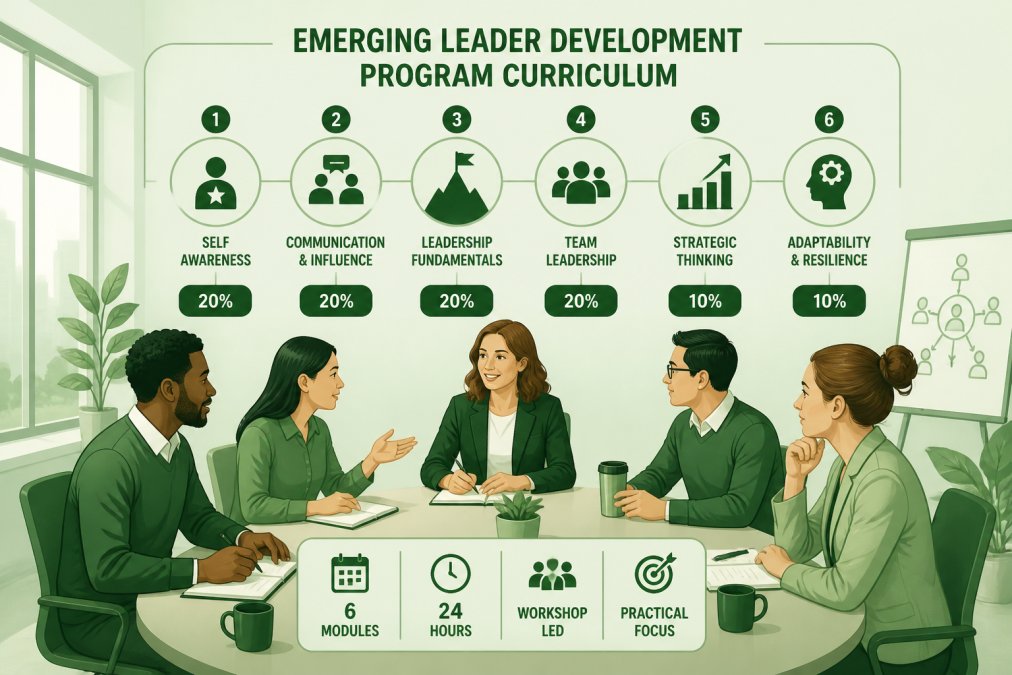
A practical curriculum framework might look like this:
| Program Component | Frequency | Duration | Focus |
|---|---|---|---|
| Foundational workshops | Monthly | 2-3 hours | Strategy, finance, systems thinking |
| Skill-building sessions | Bi-monthly | 3-4 hours | Delegation, feedback, conflict |
| One-on-one coaching | Bi-weekly | 1 hour | Application to real situations |
| Peer cohort meetings | Monthly | 1.5 hours | Peer learning and accountability |
The curriculum should include pre-program assessment and post-program evaluation to measure changes in behavior and team engagement.
Using Leadership Readiness Assessment Tools
Leadership readiness assessment tools help you move from subjective gut feel to structured evaluation of whether an emerging leader is truly ready for promotion.
A comprehensive readiness assessment should measure multiple dimensions. Competency assessments evaluate whether someone has the skills required for the next role through 360-degree feedback or structured interviews. Psychological assessments measure traits like emotional intelligence, resilience, and learning agility. Business acumen assessments evaluate whether someone understands the financial and strategic context. Organizational fit assessments look at whether values align with the culture you're building.
Combine these tools into a readiness rubric. Score each dimension 1-5, then set a threshold (say, average of 3.5 or higher) for promotion readiness. This removes bias and creates a defensible process.
Mentorship Program Templates for New Managers
Mentorship is the accelerant that turns development programs into sustained behavior change. A structured mentorship program provides emerging leaders with consistent guidance from someone who's navigated the transition successfully.
The mentor-mentee pairing should be intentional. Match emerging leaders with mentors who've been in the role they're stepping into, ideally within the last 3-5 years. The mentor should be someone the emerging leader respects and trusts.
The mentorship structure should include regular meetings (bi-weekly or monthly) with a clear agenda. A simple template might include:
- Opening (5 minutes): Check-in on how the emerging leader is feeling
- Challenge discussion (20 minutes): Emerging leader describes a specific challenge they're facing
- Mentor perspective (15 minutes): Mentor shares how they've handled similar situations
- Action planning (10 minutes): Emerging leader commits to a specific action before the next meeting
The mentorship agreement should clarify expectations: meeting frequency, confidentiality, scope, and duration (typically 6-12 months).
Mentor training is critical. Mentors need to understand they're helping emerging leaders think through problems, not solving problems for them. This requires coaching skills, asking good questions, and listening actively.

Navigating Leadership Transitions and Building Psychological Safety
The moment an emerging leader steps into a management role is the most vulnerable point in their journey. The transition from peer to manager is psychologically disorienting.
Psychological safety becomes essential. New managers need to feel safe being imperfect, asking questions, and admitting what they don't know. Frame promotion as "you're entering a new learning curve" rather than "you've arrived." Explicitly tell new managers that mistakes are how they learn and that you'll support them through the process.
The new manager's direct manager should have frequent check-ins during the first 90 days, weekly rather than monthly. These conversations should focus on how the new manager is feeling, what's confusing, and what support they need.
Peer cohorts of new managers also build psychological safety. When new managers meet regularly with others who've just stepped into management, they realize they're not alone in their confusion. Normalizing this experience reduces isolation and shame.
Remote and hybrid work environments require more intentional relationship-building. New managers need explicit guidance on building trust in distributed environments, running effective one-on-ones over video, and communicating vision when not in the same room.
Overcoming Common Leadership Challenges During Promotion
Even well-prepared emerging leaders hit predictable obstacles once they step into management.
The trust paradox is the first challenge. New managers often feel they need to prove themselves by being more decisive and in control. The counterintuitive fix is to be more vulnerable. New managers who say "I'm still learning this role, and I'd value your input" build more trust faster than those who project false confidence.
The delegation trap catches many emerging leaders. They must get results through others, which means letting go of control. Delegation at 80% quality from your team is often better than 100% quality from you, because you free yourself to focus on what only you can do as a manager.
Micromanagement and trust issues emerge when new managers don't trust their team to execute. Coaching new managers to distinguish between trust issues and real performance gaps is critical. If someone is performing well, the manager's job is to stay out of the way.
The loneliness of leadership is real. As an individual contributor, the emerging leader had peers they could be fully honest with. As a manager, they must maintain some authority distance. Creating peer groups where new managers can be completely honest with each other addresses this.
Feedback delivery remains challenging. Many new managers avoid giving feedback because they don't want to damage relationships. This backfires; problems fester and the team loses respect. New managers need practice giving feedback that is honest and kind simultaneously.
Imposter syndrome affects many new managers, particularly women and underrepresented groups. When the organization actively communicates that new managers are expected to have a learning curve, when senior leaders share their own early mistakes, and when failure is treated as data rather than judgment, imposter syndrome loses power.
The antidote to all these challenges is honest conversation. New managers need forums where they can acknowledge struggles without judgment, mentors and peers who've been through similar transitions, and senior leaders who model vulnerability.
The gap between high potential and proven leadership is narrower than most organizations think. Emerging leaders don't need to be perfect; they need intentional development, honest feedback, and psychological safety to learn.
Jim Carlough's character-driven approach to leadership development focuses on exactly this: helping emerging leaders build the identity, confidence, and authentic influence required to step into management roles and lead with impact. With 30+ years of experience in enterprise transformation, Jim works with organizations to design development programs that move beyond skills training to actual identity shifts. [BOOK JIM TO SPEAK] to bring this framework to your organization's leadership development strategy.
Frequently Asked Questions
What are the key competencies for emerging leaders?
Emerging leaders need emotional intelligence, strategic thinking, delegation skills, and impactful communication. They must demonstrate agility in adapting to change, build team resilience through coaching and feedback loops, and show collaborative leadership. Character-driven leaders also develop self-awareness, conflict resolution abilities, and the capacity to create psychological safety within their teams. These competencies bridge the gap between individual contributor success and managerial effectiveness.
How do you identify employees with leadership potential?
Look for high-potential talent who consistently exceed performance expectations, seek feedback, and show willingness to take on stretch assignments. Assess their career trajectory, ability to influence peers, and how they handle complexity. Use leadership readiness assessment tools to evaluate strategic thinking, emotional intelligence, and communication skills. In healthcare and hybrid environments, also observe how they navigate change, build trust across departments, and mentor others informally.
What should a developing emerging leaders program include?
An effective emerging leader development program curriculum combines skill-building workshops, mentorship from senior leaders, feedback loops, and real-world application. Include modules on delegation, conflict resolution, change management, and building organizational culture. Integrate coaching culture practices, succession planning frameworks, and skill gap analysis. Remote and hybrid leaders benefit from specific training on maintaining team connection and influence without physical presence. Programs should align with your organization's strategic priorities and measure progress through performance metrics and KPIs.
How does mentorship help emerging leaders prepare for promotion?
Mentorship accelerates leadership maturity by providing personalized guidance, modeling effective leadership behavior, and creating safe spaces to discuss challenges. Mentors help emerging leaders build confidence, clarify their leadership identity, and navigate organizational politics. Effective mentorship program templates for new managers include structured check-ins, clear development goals, feedback mechanisms, and accountability. This one-on-one relationship builds the psychological safety and trust needed for leaders to authentically step into their new role without micromanaging or losing credibility with their team.
This article was written using GrandRanker