 how-to
Overcoming Imposter Syndrome as an Executive: A Tactical Guide
Table of Contents
- Signs of Imposter Syndrome in Leadership Roles
- Why Overcoming Imposter Syndrome as an Executive Is Different from Entry-Level Self-Doubt
- Step 1: Build Self-Awareness Through Objective Assessment
- Step 2: Reframe Fraudulence Through Cognitive Reframing and a Growth Mindset
- Step 3: How to Build Executive Presence While Managing Self-Doubt
- Executive Coaching for Imposter Syndrome: Frameworks That Actually Work
- Step 4: Seek Peer Mentorship and Build Structured Feedback Loops
- Step 5: Measure Your Progress and Recalibrate Regularly
Last Updated: August 3, 2026
Overcoming imposter syndrome as executive is one of the most underexamined performance challenges in modern leadership. The condition is not a personality flaw or a sign of incompetence. It is a cognitive pattern that high-achievers develop precisely because they care deeply about doing their work well. Below, we'll show you exactly how to identify the specific distortions that affect leaders at the top, and the tactical steps to move through them with clarity and confidence.
Here's what most guides get wrong: they treat executive self-doubt the same way they treat entry-level anxiety. The two are fundamentally different problems, and conflating them produces advice that sounds right but lands hollow in a high-stakes environment.
Signs of Imposter Syndrome in Leadership Roles
Imposter syndrome in executive roles is a persistent internal experience in which a competent leader attributes their success to luck, timing, or external factors rather than to their own skill, judgment, or effort. The pattern is self-reinforcing: the more visible the leader's success, the more intense the fraudulence can feel.

Cognitive Distortions That High-Achievers Mistake for Humility
Perfectionism is the most common disguise. When an executive delays a decision until they feel "certain enough," they often frame it internally as thoroughness. In practice, it is performance anxiety wearing a professional mask.
Other distortions that surface frequently in leadership roles include discounting evidence (dismissing positive feedback as politeness while treating criticism as objective truth), comparative diminishment (measuring your internal experience against others' external presentation), attribution error (crediting team success to the team while absorbing personal blame for failures), and mind-reading (assuming colleagues privately question your competence despite no evidence). These patterns feel rational because they masquerade as self-reflection and critical thinking. The distinction lies in whether the self-assessment is grounded in objective data or driven by fear.
How Self-Doubt Accelerates Burnout and Performance Anxiety
Self-doubt at the executive level spreads into decision-making velocity, team dynamics, and physical health. Leaders who operate from chronic fraudulence tend to overwork as a compensatory mechanism, which accelerates burnout significantly faster than workload alone. The feedback loop is brutal: exhaustion reduces cognitive clarity, which produces worse decisions, which amplifies self-doubt, which drives more overwork. According to American Psychological Association's workplace burnout resources, chronic workplace stress is one of the leading contributors to executive health decline.
Performance anxiety also distorts risk tolerance. Leaders afraid of being "found out" tend to avoid bold moves, stick to proven playbooks, and over-rely on consensus. This is not caution. It is self-protection dressed up as strategy.
Why Overcoming Imposter Syndrome as an Executive Is Different from Entry-Level Self-Doubt
The stakes change everything. An entry-level professional doubting their competence affects their own output. An executive doubting their competence affects organizational direction, team confidence, succession pipelines, and culture. Every decision a C-suite leader makes is visible, consequential, and often irreversible on a short timeline. That visibility creates a unique pressure gradient that amplifies imposter syndrome in ways that standard self-help frameworks do not account for.
The expectation of executive presence compounds this further. Leaders are expected to project certainty even when they feel none. The gap between the internal experience and the external performance becomes exhausting to maintain, and that gap is exactly where imposter syndrome grows.
Gender and Minority-Specific Challenges in the C-Suite
Overcoming imposter syndrome as executive is not a uniform experience. Leaders from underrepresented groups, including women, people of color, and first-generation professionals, face a compounded version of this challenge. They carry the weight of imposter syndrome alongside systemic barriers that are external, not internal. For these leaders, the fraudulence feeling is often reinforced by real environmental signals: rooms where they are the only person who looks like them, legacy cultures that were not built with their professional identity in mind, and a scarcity of peer mentors who share their lived experience.
According to Harvard Business Review's research on imposter syndrome and identity, the pressure to conform to dominant cultural norms in the workplace significantly intensifies imposter syndrome for leaders from minority backgrounds. Acknowledging this systemic dimension is essential context for understanding why generic confidence-building advice often fails these leaders.
Step 1: Build Self-Awareness Through Objective Assessment
Self-awareness is the entry point, but not the vague, journaling kind. The goal is objective assessment: a structured examination of what the evidence actually says about your competence, separate from how you feel about it.
Start with a concrete audit: List the five most significant decisions you made in the last 12 months, document the outcome and feedback for each, identify which outcomes you attributed to yourself versus external factors, and note any pattern of systematic self-exclusion from credit. This exercise is not about inflating your ego. It is about recalibrating your internal success metrics against reality. Most executives who complete this audit find that they have been applying a double standard: holding themselves to a much harsher evidentiary threshold than they apply to others.
Step 2: Reframe Fraudulence Through Cognitive Reframing and a Growth Mindset
Cognitive reframing is the process of deliberately examining a belief, identifying the distortion embedded in it, and replacing it with a more accurate interpretation. This is not positive thinking. It is structured correction of faulty reasoning.
A growth mindset, the understanding that ability develops through effort and learning rather than being fixed at birth, is the philosophical foundation that makes reframing sustainable. Practical reframing steps for executive self-doubt: (1) Name the thought: "I don't belong in this room." (2) Identify the distortion: All-or-nothing thinking, discounting evidence. (3) Challenge it with data: "I was selected for this role after a competitive process. My track record includes X, Y, Z." (4) Replace with a calibrated statement: "I have gaps to address, and I also have qualifications that earned this seat." The goal is not to feel great. The goal is to think accurately.
Step 3: How to Build Executive Presence While Managing Self-Doubt
Executive presence is not the absence of self-doubt. It is the ability to operate with authority and clarity despite it. Leaders who wait until they feel confident before projecting confidence are waiting for something that never arrives on its own. You do not need to feel certain to speak with clarity. You do not need to feel powerful to hold the room.
Internalized Success vs. External Validation
The most resilient leaders have internalized their success metrics rather than depending on external validation to feel competent. External validation is unreliable: it fluctuates with organizational politics, market conditions, and the mood of the room. Internalized success means you have a clear, personal definition of what good leadership looks like, and you measure yourself against that standard rather than against others' approval. This shift directly reduces the grip of imposter syndrome, because the fraudulence feeling is largely driven by the fear of being judged negatively by others.
Executive Coaching for Imposter Syndrome: Frameworks That Actually Work
Executive coaching is the most direct intervention available for overcoming imposter syndrome as executive, and the most effective frameworks combine self-awareness work with behavioral accountability and peer-level challenge.
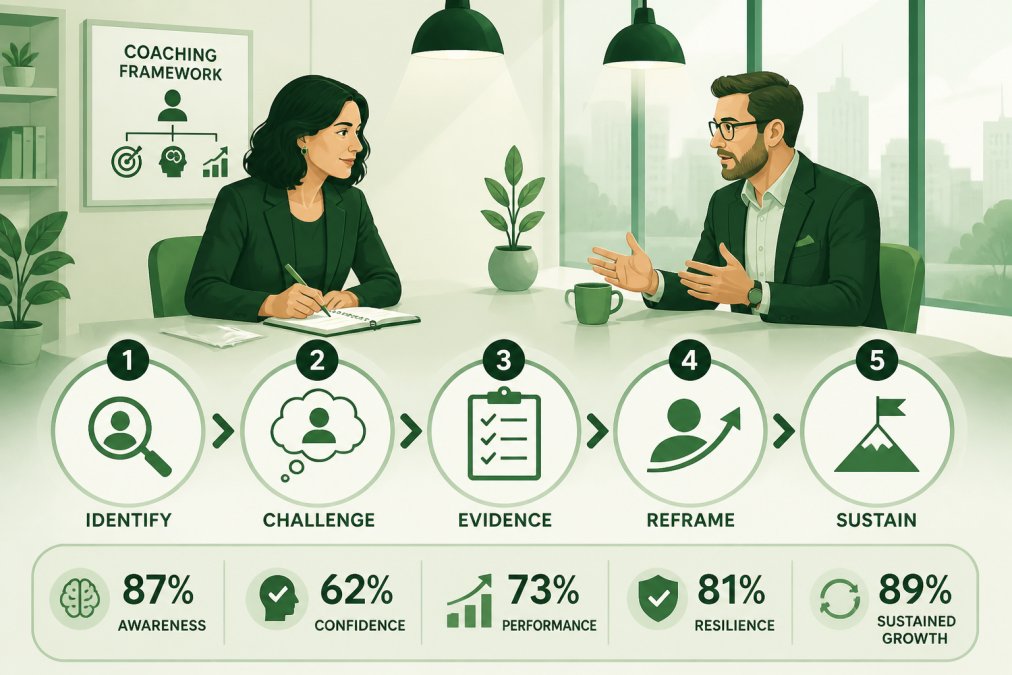
The most effective coaching engagements move through three phases:
| Phase | Focus | Key Activity |
|---|---|---|
| Awareness | Identifying distortions | Cognitive audit and evidence review |
| Reframing | Replacing faulty beliefs | Structured reframing exercises |
| Accountability | Sustaining new patterns | Feedback loops and peer challenge |
Jim Carlough's approach to executive coaching is built on over 30 years of enterprise transformation experience and grounded in character-driven leadership development. Rather than focusing on surface-level confidence techniques, the work centers on professional identity: who you are as a leader, separate from the title you hold. This distinction matters because imposter syndrome is fundamentally an identity problem, not a skills gap.
How Organizational Culture Either Feeds or Defuses Imposter Syndrome
Organizational culture is the variable that most leadership articles on this topic ignore entirely. An individual leader can do all the right internal work and still be undermined by a culture that punishes vulnerability, rewards performative certainty, and lacks psychological safety.
Psychological safety, the belief that you can speak up, admit uncertainty, or challenge assumptions without fear of punishment, is the organizational condition that most directly reduces imposter syndrome at the leadership level. According to Google's Project Aristotle research on psychological safety, psychological safety is the single most important factor in high-performing teams. CHROs and VPs of Talent Development have a specific lever here: they can build the structural conditions that make it safe for leaders to acknowledge self-doubt without it being weaponized against them.
Step 4: Seek Peer Mentorship and Build Structured Feedback Loops
Peer mentorship is the most underused resource for senior leaders dealing with imposter syndrome. The isolation of executive roles is real: there are very few people inside your organization with whom you can discuss self-doubt without risking your credibility. Structured peer mentorship through executive peer groups, industry cohorts, or facilitated leadership circles creates a context where senior leaders can speak honestly about the fraudulence experience and discover that it is nearly universal among high-achievers.
Structured feedback loops are equally critical. Imposter syndrome thrives in the absence of honest, specific feedback. Without it, the internal narrative fills the void. Effective feedback loops include 360-degree assessments conducted by a neutral facilitator, quarterly developmental conversations with a direct superior or board member focused on growth, and peer challenge sessions where colleagues are explicitly invited to push back on your thinking. The key word is "structured." Informal feedback is too easily filtered through the imposter syndrome lens.
Step 5: Measure Your Progress and Recalibrate Regularly
Overcoming imposter syndrome as executive is not a one-time achievement. It is an ongoing practice of recalibration, and like any leadership discipline, it requires measurement to sustain progress.
A simple progress framework: (1) Monthly, Review your wins log and note any moments where you caught a cognitive distortion in real time and corrected it. (2) Quarterly, Revisit your objective assessment audit and assess whether your attribution pattern has shifted. (3) Annually, Assess your relationship with external validation and whether you are more grounded in internalized success metrics.
Career trajectory changes, new roles, economic pressure, and organizational upheaval can all reactivate imposter syndrome in leaders who had previously worked through it. The goal is not to be immune to it. The goal is to have a reliable, practiced response when it surfaces. According to American Management Association's leadership development resources, the leaders who sustain the most consistent performance over time are those who treat their own professional development with the same rigor they apply to organizational strategy.
| Step | Focus Area | Frequency | Key Tool |
|---|---|---|---|
| 1 | Self-awareness audit | One-time, then annually | Evidence inventory |
| 2 | Cognitive reframing | Ongoing, daily | Wins log |
| 3 | Executive presence | Ongoing, behavioral | Presence checklist |
| 4 | Peer mentorship | Monthly | Peer group or coach |
| 5 | Progress measurement | Monthly / Quarterly | Recalibration review |
The real measure of progress is not whether you feel confident all the time. It is whether self-doubt has stopped making your decisions for you.
Imposter syndrome at the executive level is a systemic issue, not a personal weakness, and it requires a structured, sustained response. Jim Carlough's executive coaching and keynote programs are built on 30+ years of enterprise transformation experience, with a specific focus on character-driven leadership and professional identity development: the two foundations that make lasting change possible. If you're ready to lead from a place of clarity and genuine confidence, BOOK JIM TO SPEAK and bring this work directly to your organization.
Frequently Asked Questions
Why do high-achieving executives experience imposter syndrome more intensely than other professionals?
High-achievers often face a widening gap between their perceived competence and the scope of their new responsibilities during a leadership transition. The higher the stakes, the louder the self-doubt. Perfectionism compounds this: executives set extreme internal benchmarks, and any shortfall feels like proof of fraudulence rather than a normal part of professional development. The visibility of the C-suite also removes the anonymity that once buffered mistakes, making performance anxiety feel more acute and public.
What are the most telling signs of imposter syndrome in leadership?
Common signs of imposter syndrome in leadership include over-preparing for routine decisions, deflecting credit to the team while privately discounting your own contribution, avoiding high-visibility opportunities to reduce the risk of exposure, and micromanaging direct reports because you distrust your own judgment. Executives also frequently attribute career success to luck or timing rather than to earned competence. If any of these patterns show up consistently, they are worth addressing directly rather than treating as standard executive humility.
Can executive coaching for imposter syndrome actually change behavior, or is it just motivational?
Structured executive coaching for imposter syndrome works through specific frameworks: objective achievement audits, cognitive reframing exercises, and accountability feedback loops that replace vague reassurance with measurable behavioral change. A skilled coach helps you separate factual performance data from distorted self-narrative. Over time, this builds internalized success metrics rather than dependence on external validation. The process is practical and iterative, not motivational in the generic sense, and progress can be tracked against concrete leadership behaviors.
How do I build executive presence when I still feel like a fraud inside?
Building executive presence does not require eliminating self-doubt first. It requires acting from your professional identity while the doubt is still present. Practical steps include anchoring decisions to documented competencies, practicing deliberate self-disclosure with trusted peers to reduce the isolation that amplifies fraudulence, and creating structured reflection routines that surface objective evidence of impact. Emotional intelligence skills, particularly self-regulation under pressure, are the visible expression of presence that others read as confidence, even when your internal experience differs.
How does organizational culture contribute to imposter syndrome in senior leaders?
Cultures that reward heroic individual performance, punish visible vulnerability, or lack psychological safety push executives to mask self-doubt rather than address it. When admitting uncertainty is treated as a weakness, imposter syndrome goes underground and intensifies. Organizations that normalize peer mentorship, transparent feedback loops, and character-driven leadership create conditions where executives can recalibrate their self-perception against real data, which is the most reliable long-term antidote to chronic feelings of fraudulence at the senior level.
This article was written using GrandRanker